(They looked them over carefully.)look upsearch in a listYou've misspelled this word again. She picked out the guy she thought had stolen her purse.pick uplift something off something elseThe crane picked up the entire house. (Watch them pick it up.)point outcall attention toAs we drove through Paris, Francoise pointed out the major historical sites.put awaysave or storeWe put away money for our retirement. She put away the cereal boxes.put offpostponeWe asked the boss to put off the meeting until tomorrow. (Please put it off for another day.)put onput clothing on the bodyI put on a sweater and a jacket.

(I put them on quickly.)put outextinguishThe firefighters put out the house fire before it could spread. (They put it out quickly.)read overperuseI read over the homework, but couldn't make any sense of it.set upto arrange, beginMy wife set up the living room exactly the way she wanted it. She set it up.take downmake a written noteThese are your instructions. Write them down before you forget.take offremove clothingIt was so hot that I had to take off my shirt.talk overdiscussWe have serious problems here.

Let's talk them over like adults.throw awaydiscardThat's a lot of money! It really turned me off.turn onswitch on the electricityTurn on the CD player so we can dance.use upexhaust, use completelyThe gang members used up all the money and went out to rob some more banks. Moreover, phrasal verbs can be intransitive -- not followed by a direct object – or transitive – followed by a direct object. Therefore, phrasal verbs can be separable, inseparable, transitive or intransitive .
Verb + preposition When the element is a preposition, it is the head of a full prepositional phrase and the phrasal verb is thus prepositional. These phrasal verbs can also be thought of as transitive and non-separable; the complement follows the phrasal verb.a. – after is a preposition that introduces the prepositional phrase after the kids.b. – on is a preposition that introduces the prepositional phrase on nobody.c. – into is a preposition that introduces the prepositional phrase into an old friend.d.

– after is a preposition that introduces the prepositional phrase after her mother.e. – for is a preposition that introduces the prepositional phrase for a linguist.f. These verbs can be transitive or intransitive. If they are transitive, they are separable.a.
– up is a particle, not a preposition.b. – over is a particle, not a preposition.c. – down is a particle, not a preposition.d. – in is a particle, not a preposition.e. – out is a particle, not a preposition.f.

– in is a particle, not a preposition.Verb + particle + preposition (particle-prepositional verbs)Many phrasal verbs combine a particle and a preposition. Just as for prepositional verbs, particle-prepositional verbs are not separable.a. – up is a particle and with is a preposition.b.

– forward is a particle and to is a preposition.c. The other tanks were bearing down on my Panther. – down is a particle and on is a preposition.d. They were really teeing off on me. – off is a particle and on is a preposition.e. – up is a particle and on is a prepositionf.

Susan has been sitting in for me. – in is a particle and for is a preposition. Each of the following sentences uses a phrasal verb. Read each sentence carefully and figure out exactly what the sentence is trying to say. Often, phrasal verbs have different meanings than a verb being modified by adverbs or prepositional phrases. You may also notice that some of these phrasal verbs can be separated out and the sentence will still make sense. OK then Fabio, I hope that you've learned today that phrasal verbs can have lots of different meanings and that context is absolutely vital for working out what the different meanings are.

You can also help yourself to understand phrasal verbs by buying a really good English-English learner dictionary, which have lots of definitions and example sentences too. So, good luck Fabio with phrasal verbs. The word parts of transitive phrasal verbs either can be separated, that is the particle can be separated from the verb by the direct object, or cannot be separated. Phrasal verb.1 She looked his address up.
Phrasal verb.2 When he heard the crash, he looked up. Not a phrasal verb.2 When he heard the crash, he looked up at the sky. Not a phrasal verb.The terminology used to denote the particle is also inconsistent.

Sometimes it is called an adverb and at other times an intransitive prepositional phrase. The inconsistent use of terminology in these areas is a source of confusion over what qualifies as a phrasal verb and the status of the particle or a preposition. The words "phrasal verbs" might sound intimidating, but in truth, they shouldn't be. "Phrasal verbs" are, after all, simply verb phrases – multi-word verbs that are formed by combining ordinary verbs like look, bring, come, and go with prepositions or adverbs such as in, on and over. There is no magic method for learning phrasal verbs. It takes time, patience and commitment.

If you want to sound more natural when speaking English, you need to take the time to practice phrasal verbs and get more confident with using them. So, try the techniques you learned today and make a commitment to practice regularly. Share your examples below and if you found this useful, please spread the knowledge and share it with your friends. Phrasal verbs are an important part of learning the English language. Most phrasal verbs consist of two words (verb + adverborverb + preposition) but a few consists of three words.

Think of them as you would any other English vocabulary. Study them as you come across them, rather than trying to memorise many at once. Some phrasal verb meanings are obvious—like "fall down"—but some are almost like idioms since they can't be literally translated.

To make them easier to learn, you can try grouping the phrasal verbs into categories, like we've done with our phrasal verbs list below. This study investigates the hitherto understudied area of the use of phrasal verbs in expert academic writing in the discipline of Linguistics. Using a specifically designed corpus of L1 English academic expert writing in Linguistics, we investigate the frequency and meanings of PVs in this sample. Contrary to previous findings, our results indicate that PVs form a large proportion of verbs identified in expert writing. We conclude our study by suggesting some recommendations for introducing phrasal verbs into the teaching repertoire of English for Academic Purposes. Although phrasal verbs are acceptable in spoken English, they are frequently considered too informal for academic writing.

Furthermore, phrasal verbs often have multiple meanings. Your aim is to write your paper in a simple language that makes your work clear and concise. It is therefore recommended that you replace phrasal verbs with formal one-word alternatives. A complex aspect of phrasal verbs concerns the distinction between prepositional verbs and particle verbs that are transitive . Particle verbs that are transitive allow some variability in word order, depending on the relative weight of the constituents involved.

Shifting often occurs when the object is very light, e.g. There are hundreds of phrasal verbs so you obviously can't learn them all together like a list of vocabulary. You need to consider them like any other verb that needs to be learnt.

When you come across a new phrasal verb, pay particular attention to it. Try to understand the meaning from the context, then if you still don't understand, look it up in the dictionary. Try to use an English monolingual dictionary so you read the definition and synonyms in English. Separable phrasal verbs follow different rules, however.

For starters, separable phrasal verbs are always transitive, so they always have a direct object. Unfortunately, this can sometimes seem easier in practice than in theory. Still, while there are no foolproof rules that dictate the when and why of these combinations, a little bit of grammar can make phrasal verbs much easier to manage. In fact, before we can even begin a discussion of phrasal verbs, we need to understand the difference between the subject and the object of a sentence. Remember that phrasal verbs can be either separable or inseparable . Each phrasal verb is also marked as separable or inseparable .

In the case that verbs are separable, examples will use the separable form of the phrasal verb. For inseparable phrasal verbs, examples keep the phrasal verbs together. Now that you know what verbs, adverbs, prepositions and particles are, you're ready to start putting them together into phrasal verbs. A phrasal verb is an idiomatic phrase which consists of a verb and something else. So, for example, 'give up' is a phrasal verb. Here, 'give' is the verb, and 'up' is a preposition following it, and together they mean to stop doing something.

What is the meaning of phrasal verb go on So, you could say, 'I'm going to give up eating chocolate,' meaning that you're not going to eat chocolate anymore, (although I don't think many people have ever wanted to do this). To make things more complicated, they often have more than one meaning, but hopefully we'll be able to help you understand what certain phrases mean. The terminology of phrasal verbs is inconsistent. Modern theories of syntax tend to use the term phrasal verb to denote particle verbs only; they do not view prepositional verbs as phrasal verbs.

In contrast, literature in English as a second or foreign language ESL/EFL, tends to employ the term phrasal verb to encompass both prepositional and particle verbs. As you learn new phrasal verbs, think about how YOU would use them. Write phrases or sentences you may use in the future that use those phrasal verbs, and review them regularly. Just a couple minutes of reviewing your list each day can make a big difference in your ability to use those terms while you're speaking. The problem with phrasal verbs lies in their second element which is, for reasons that I do not find very clear, most of the times called a PARTICLE. According to some, a particle can be either a preposition or an adverb.
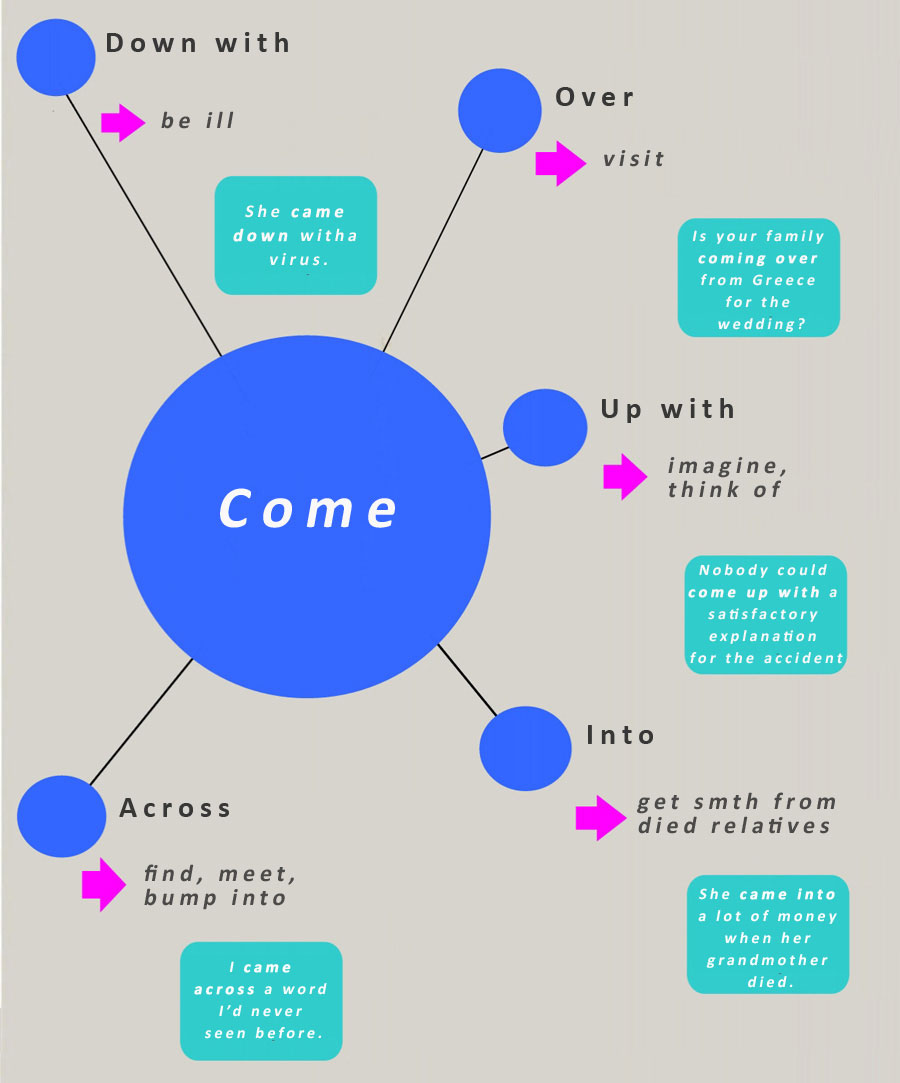
If we believe others, it can only be an adverb (The verb+ preposition compounds are then simply called prepositional verbs). In this lesson, you'll learn 10 phrasal verbs using the verb COME. Phrasal verbs are groups of words in English, made up of a verb and either one or two particles. A particle can be either a preposition, like 'on' or an adverb like 'together'. The Oxford dictionary, defines phrasal verbs as a verb that is made up of a main verb together with an adverb or a preposition or both. Typically, their meaning is not obvious from the meanings of the individual words themselves.

The two categories have different values. Particle-verb compounds in English are of ancient development, and are common to all Germanic languages, as well as to Indo-European languages in general. Those such as onset tend to retain older uses of the particles; in Old English on/an had a wider domain, which included areas now covered by at and in in English.

Some such compound nouns have a corresponding phrasal verb but some do not, partly because of historical developments. The modern English verb+particle complex set on exists, but it means "start to attack" . Verb-particle compounds are a more modern development in English, and focus more on the action expressed by the compound. That is to say, they are more overtly verbal. We can't add a direct object to this phrasal verb because it's intransitive.

While it can mean to look at the ceiling, look up more commonly means "to search for information" and, perhaps more importantly still, this meaning is neither informal nor particularly uncommon. So do you see why understanding the particles and their possible meanings is so important? This will take time and practice because out has many different tendencies, but it's definitely worth your time and effort.
It will at least give you an idea of what the phrasal verb could mean. Instead of grouping them by verb, organizing phrasal verbs by particle can help you make relevant connections between them. That's because the particles have tendencies, and if you understand these tendencies, it'll make learning phrasal verbs a bit easier. Now, what if I told you that learning how to use phrasal verbs in your conversations is entirely possible? It's simply the result of using the right techniques. I'm not saying that the methods I'm going to show you are the only ones out there.

But over the years I've spent time studying the best ways to teach phrasal verbs and today I want to share with you 5 secrets I've learned from my experience and research. You can use the list below as a reference guide when you find an expression that you don't recognise. The examples will help you understand the meanings. Like many other verbs, phrasal verbs often have more than one meaning. Sometimes it is difficult to understand the meaning of phrasal verbs.

Before looking them up in a dictionary, it would be helpful to use the context to understand them. The word parts that make up an intransitive phrasal verb cannot be separated. A sentence with an intransitive phrasal verb does not have an object.

First, there are very, very many phrasal verbs and it can be hard to know where to start. However, two linguists called Mélodie Garnier and Norbert Schmitt have made a very useful list of the 150 most common ones. My explanations below each look at 15 of the most common phrasal verbs. English phrasal verbs are everywhere, so one of the best ways to learn them is to try to listen for them.


No comments:
Post a Comment
Note: Only a member of this blog may post a comment.